• June 9, 2026
In-Home ABA Therapy Georgia: Your Child, Your Space, Your Growth
By the Haim ABA Team | ABA Therapy | June 2026
Some children do their bravest learning in the place they know best: home.
Your child already knows the rhythm of your home. The sound of a cabinet opening. The chair they always choose. The corner where their favorite toy waits. The small routines that make the day feel familiar.
For many children with autism, that familiarity is more than comfort. It can become the doorway into meaningful growth.
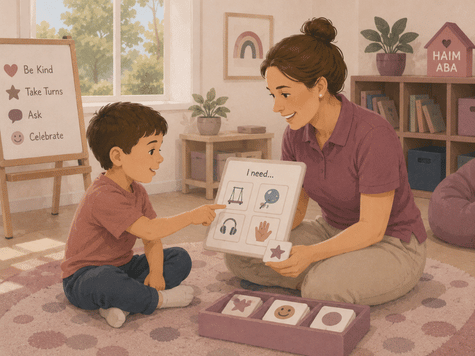
In-home ABA therapy in Georgia brings individualized autism support into your child’s real world, where everyday skills are not just taught, but practiced in the places they matter most. Washing hands at the bathroom sink. Asking for help in the kitchen. Moving through a morning routine. Playing with a sibling. Sitting at the dinner table. Calming after a hard transition.
At Haim ABA, in-home therapy is guided by Kind ABA™ — ABA rooted in kindness, genuine connection, and celebrating each child’s personality. We bring clinical structure into the home without making your home feel clinical. Your child is supported in their space, at their pace, with a team that sees the whole person behind the diagnosis.
What In-Home ABA Therapy Means
In-home ABA therapy means a trained therapist comes to your home to work with your child in their natural environment. Sessions are built around your child’s individualized treatment plan and supervised by a Board Certified Behavior Analyst, or BCBA.
This is not therapy removed from real life. It is therapy woven directly into it.
Instead of practicing a skill in an unfamiliar room and hoping it carries over later, your child can practice that skill where it naturally happens. Communication can be practiced during snack time. Transitions can be supported between favorite activities. Daily living skills can be taught inside the actual routines your family uses every day.
For many families, that makes home-based ABA therapy in Georgia feel more practical, more personal, and easier to connect with daily life.
To understand the broader clinical foundation behind ABA, visit the Autism and ABA page.
Why Home Can Be a Powerful Place to Learn
Children do not live their lives in therapy rooms. They live them in kitchens, bedrooms, backyards, cars, classrooms, grocery stores, and family routines.
That is why in-home ABA can be especially helpful for children who need support with skills that show up most clearly at home. A child may struggle with bedtime, mealtime, getting dressed, brushing teeth, sharing with siblings, following directions, tolerating changes, or communicating needs during ordinary family moments.
In-home therapy allows the team to see those moments in context. Not as abstract goals. Not as notes on a page. As real situations your family experiences every day.
From there, the therapist and BCBA can shape support around your child’s actual life. The result is therapy that feels less separate from home and more useful inside it.
The Haim ABA Approach to Home-Based Therapy
Haim ABA’s in-home programs are built around clinical care with a human center.
Every child begins with an assessment led by a BCBA. The goal is to understand your child’s strengths, needs, communication style, daily routines, challenges, preferences, and family goals. From there, the BCBA creates a treatment plan that fits your child rather than forcing your child into a preset model.
Registered Behavior Technicians provide direct therapy during sessions, while the BCBA continues to supervise, review progress, analyze data, adjust goals, and guide the program over time.
But the Haim ABA difference is not only what we do. It is how we do it.
Kind ABA™ means your child is never treated like a project to fix. They are treated as a child with personality, preferences, humor, frustration, strengths, and potential. Therapy is structured, but not cold. Goal-driven, but not mechanical. Evidence-based, but still warm enough to feel safe.
You can learn more about the values behind this approach on the Why Haim page.
When In-Home ABA Therapy May Be the Right Fit
In-home ABA therapy may be a strong option when a child learns best in familiar spaces, has difficulty adjusting to new settings, needs support with home routines, or benefits from one-on-one therapy in a quieter environment.
It may also be helpful for younger children beginning therapy for the first time, families who need support with daily living skills, or children who are working on goals that should transfer directly into home life.
Some families use in-home ABA as their primary service. Others use it alongside center-based therapy, school-based support, or parent training. The right model depends on your child’s assessment, your family’s goals, insurance authorization, and what setting will create the best path forward.
Haim ABA’s intake and clinical teams help families decide what level of support makes sense now, while staying flexible as the child grows.
To see how the process unfolds from intake to treatment planning, visit Our Process.
Parent Training Inside the Moments That Matter
Parent training is not an extra at Haim ABA. It is part of the work.
Children make stronger progress when families understand what is being taught, why it matters, and how to support it between therapy sessions. In-home ABA creates natural opportunities for parent coaching because the therapy team can support real routines as they happen.
That might mean helping a parent respond to communication attempts during breakfast. Practicing a calmer transition from screen time to bath time. Supporting a sibling interaction. Making a difficult routine feel more predictable. Helping parents understand what to do when a strategy works beautifully in session but feels harder during a busy Tuesday evening.
The goal is not to turn parents into therapists. The goal is to help parents feel less alone, more confident, and more equipped inside everyday family life.
In-Home ABA Therapy Across Georgia
Haim ABA provides ABA therapy services for families throughout Georgia, with a clinic hub in Cumming and support extending into homes, schools, and communities.
Families searching for in-home ABA therapy Georgia or home-based ABA therapy Georgia often come from Cumming, Atlanta, Alpharetta, Marietta, Roswell, Sandy Springs, Johns Creek, Duluth, Lawrenceville, Gainesville, Canton, Buford, Woodstock, Decatur, Suwanee, Forsyth County, Cherokee County, Gwinnett County, Fulton County, DeKalb County, and surrounding areas.
If you are not sure whether Haim ABA can serve your area, the best next step is to reach out. The team can discuss your location, your child’s needs, and which service options may be available.
To review service availability, visit Our Locations.
Insurance Coverage for In-Home ABA Therapy
For many parents, the biggest question is not whether ABA could help. It is whether insurance will make therapy possible.
In Georgia, many major insurance plans, Georgia Medicaid, PeachCare for Kids, and other coverage programs may cover ABA therapy for children with autism when services are medically necessary and authorized by the plan.
Haim ABA helps families navigate that process. The intake team can verify benefits, explain documentation requirements, help with authorization, and clarify what your child’s coverage may include before services begin.
Insurance should not feel like a maze you have to walk alone.
To learn more, visit the Insurance page.
Getting Started With In-Home ABA Therapy
Beginning therapy can feel like a large step, especially if your child was recently diagnosed. Haim ABA keeps the process clear.
You start by reaching out or taking the quiz. From there, the intake team gathers basic information about your child, diagnosis, goals, location, and insurance coverage. Once the next steps are clear, a BCBA completes an assessment and develops an individualized treatment plan.
After the plan is reviewed and authorized, Haim ABA matches your child with the right therapy team and schedule.
Every family arrives with different questions. Some are ready to begin quickly. Others need time to understand insurance, compare service models, or decide whether in-home therapy is the right first step. Wherever you are in the process, the team can help you move forward with clarity.
To begin online, visit Get Started.
Frequently Asked Questions
How many hours per week does in-home ABA therapy typically involve?
The number of hours depends on your child’s assessment, age, needs, goals, and insurance authorization. Many children receive between 10 and 25 hours per week of in-home ABA therapy, though recommendations vary.
Can in-home ABA therapy work alongside school-based services?
Yes. Many families use in-home ABA therapy alongside school-based services, center-based therapy, or parent training. Your child’s BCBA can help coordinate goals across settings when appropriate.
What does a typical in-home ABA therapy session look like?
A trained therapist works with your child on goals from the treatment plan using structured and naturalistic activities. Sessions may include communication practice, play-based learning, daily living skills, routines, transitions, and parent check-ins.
Is in-home ABA therapy available in North Georgia cities like Gainesville and Canton?
Yes. Haim ABA serves families across North Georgia, including Gainesville, Canton, Cumming, Alpharetta, and surrounding communities. Availability may depend on location, staffing, clinical fit, and insurance authorization.
Does Georgia Medicaid or PeachCare cover in-home ABA therapy?
Georgia Medicaid and PeachCare for Kids may cover ABA therapy when it is medically necessary for a child with autism and authorized by the plan. Haim ABA can help verify your child’s benefits during intake.
What makes Haim ABA different from other in-home ABA providers in Georgia?
Haim ABA combines BCBA-supervised care, individualized treatment planning, parent training, and Kind ABA™ — a philosophy rooted in kindness, genuine connection, and celebrating each child’s personality.
Your Next Step
If home feels like the safest place for your child to begin, Haim ABA can help you understand whether in-home ABA therapy is the right fit. Our team will guide you through services, insurance, and the path forward.
Or call 855-511-HAIM (4246) to speak with our team.